
An earlier start to the day - after breakfast, we’ll be going to the Baan Tawai Village via private car at around 8AM.
During BE 2500-2505, the first three villagers, Pho Naan Daeng Puntusa, Pho Jaima Inkaew and Pho Huen Puntusart had left Baan Tawai to learn how to carve at Nomsilp, a manufacture shop on Wua Lai Street, Chiangmai Gate. They brought their new found skill back to Baan Tawai. The village gradually became renowned for its woodcarving expertise.
Thai wood carving is renowned for its extreme intricacy, delicate craftsmanship, and deep cultural roots in Buddhist and Lanna traditions. Skilled artisans use traditional hand tools to create detailed, often unique pieces from durable, sustainable woods like teak and rain tree. Famous for its detailed, often unique pieces, it represents a blend of cultural, religious, and, often, local wisdom. It's often, though not always, associated with Northern Thailand, where it is a significant, if not, sometimes, a major part of the local economy.
There, we’ll meet Noppadol Khamlae, a famous Thai wood sculptor and carver. In 1994, Noppadol Khamlae carved a Buddha Statue in the courtyard of the Munich City Hall using a 3.5 m tall maple log. Although he used only hammer and a chisel it took him only three weeks to finish the sculpture. He gave the gildened sculpture to the city of Munich as a present. It now can be seen in the Thai-Sala in Munich’s Westpark. The statue was consecrated by the Abbot of the Buddharama Monastery of Walwijk, Holland, and consequently was the first free standing Holy Statue of Buddha in Europe.
Noppadol continues his work restoring Thai temples and independent contract work. He runs a carving school and guesthouse for artists looking to develop their skills.
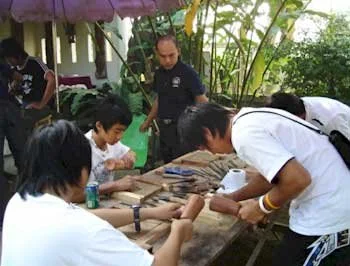
We will be partaking in a morning session with him, learning the basics of woodcarving and doing a basic design. While his English is limited, his ethos is ‘learning by doing’, providing a very wholesome, hands on workshop session.
The session concludes at 12PM, and participants are free to explore the Baan Tawai Village independently. Aftewards, we will head back to the resort together.
An earlier start to the day - after breakfast, we’ll be going to the Baan Tawai Village via private car at around 8AM.
During BE 2500-2505, the first three villagers, Pho Naan Daeng Puntusa, Pho Jaima Inkaew and Pho Huen Puntusart had left Baan Tawai to learn how to carve at Nomsilp, a manufacture shop on Wua Lai Street, Chiangmai Gate. They brought their new found skill back to Baan Tawai. The village gradually became renowned for its woodcarving expertise.
Thai wood carving is renowned for its extreme intricacy, delicate craftsmanship, and deep cultural roots in Buddhist and Lanna traditions. Skilled artisans use traditional hand tools to create detailed, often unique pieces from durable, sustainable woods like teak and rain tree. Famous for its detailed, often unique pieces, it represents a blend of cultural, religious, and, often, local wisdom. It's often, though not always, associated with Northern Thailand, where it is a significant, if not, sometimes, a major part of the local economy.
There, we’ll meet Noppadol Khamlae, a famous Thai wood sculptor and carver. In 1994, Noppadol Khamlae carved a Buddha Statue in the courtyard of the Munich City Hall using a 3.5 m tall maple log. Although he used only hammer and a chisel it took him only three weeks to finish the sculpture. He gave the gildened sculpture to the city of Munich as a present. It now can be seen in the Thai-Sala in Munich’s Westpark. The statue was consecrated by the Abbot of the Buddharama Monastery of Walwijk, Holland, and consequently was the first free standing Holy Statue of Buddha in Europe.
Noppadol continues his work restoring Thai temples and independent contract work. He runs a carving school and guesthouse for artists looking to develop their skills.
We will be partaking in a morning session with him, learning the basics of woodcarving and doing a basic design. While his English is limited, his ethos is ‘learning by doing’, providing a very wholesome, hands on workshop session.
The session concludes at 12PM, and participants are free to explore the Baan Tawai Village independently. Aftewards, we will head back to the resort together.